FAIR Language Resources in NLP: Stewardship, Reuse and Long-Term Sustainability
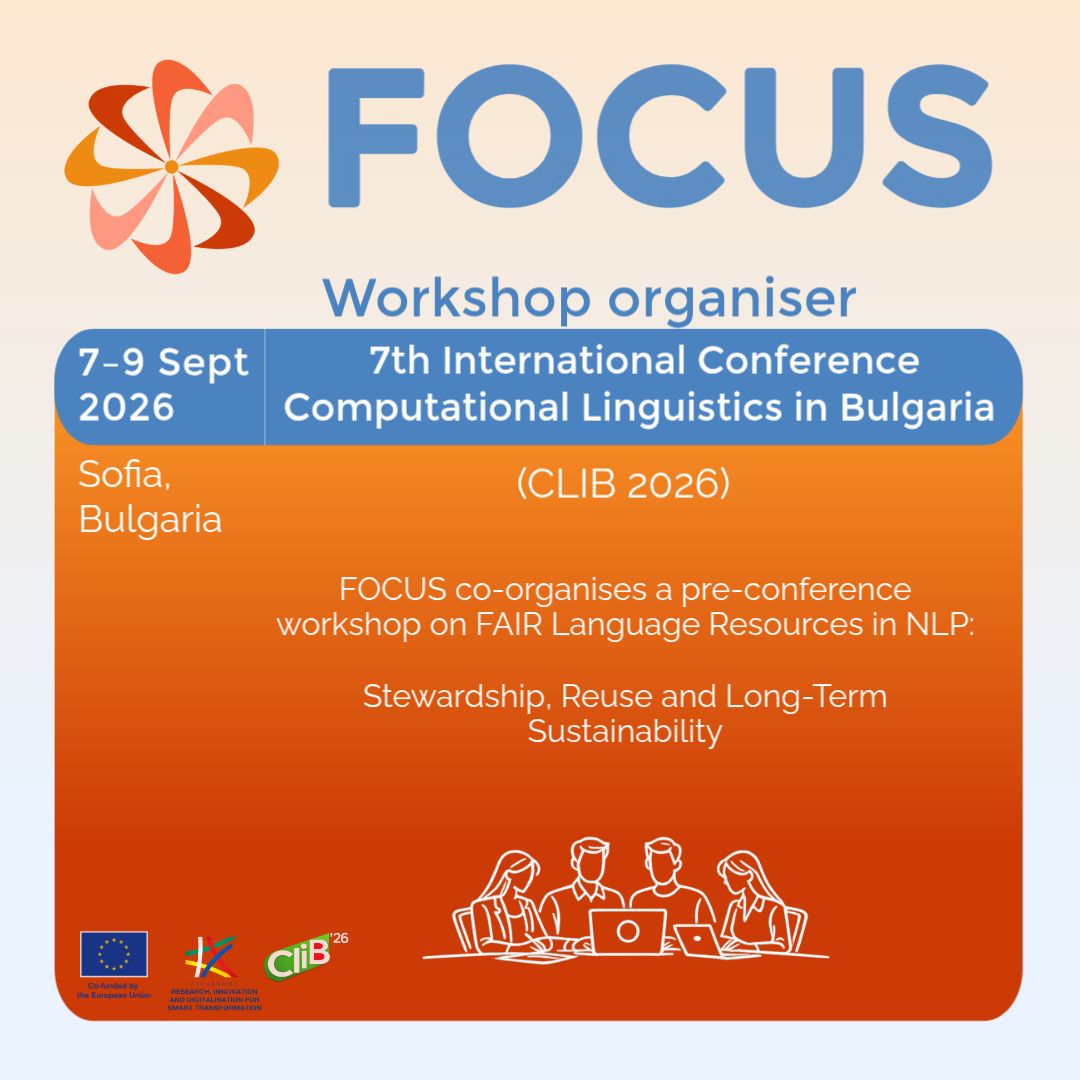
calendar_month Sep 7, 2026
location_on Sofia, Bulgaria
Event details
Language resources are the foundation of linguistic research and NLP. Corpora, lexicons, annotated datasets, benchmarks, and models are produced at an unprecedented pace. Yet their long-term stewardship, interoperability, and reuse remain inconsistent and often fragile. Rapid creation has outpaced sustainable design.
This workshop aims to bring together researchers, infrastructure providers, data stewards, and policy actors who are committed to building durable language resource ecosystems. We aim to address the pressing challenges of sustaining datasets used in linguistic research and in the development of NLP systems—from documentation and versioning to governance, licensing, and infrastructure support.
The workshop will explore how FAIR principles (Findable, Accessible, Interoperable, Reusable) can be meaningfully operationalised for language resources in NLP and computational linguistics.
Call for Papers (CFP)
We invite short papers (4–6 pages) presenting original work, position papers, case studies, tools, infrastructure approaches, and critical reflections related to FAIR and sustainable language resources.
The submissions should use the CLIB template. Please use the final submission template. Submissions to the workshop are not anonymous.
Topics of Interest
1. Technical Foundations
Designing language resources so they are interoperable, transparent, and structurally reusable.
-
Domain-specific FAIR implementation strategies for corpora, lexicons, datasets, and models
-
Metadata, paradata, and annotation transparency frameworks
-
Repository architectures and infrastructure design for linguistic data
2. Lifecycle & Reuse
-
Ensuring language resources remain usable, traceable, and measurable across research cycles.
-
From raw data to FAIR-ready assets: preprocessing, cleaning, and quality assurance workflows
-
Documentation, versioning, and provenance tracking for evolving resources
-
Persistent identifiers and citation mechanisms for language datasets
-
Methods for tracking, measuring, and evidencing reuse
-
Critical reflections and lessons learned from implementation challenges
-
Replicability of the experiments over the language resources
3. Policy & Sustainability
Creating the institutional and legal conditions that allow language resources to endure.
-
Legal, ethical, and licensing considerations in sharing and reusing language data
-
Governance structures and sustainability models beyond project funding
Submission Guidelines
Length: 4–6 pages (excluding references)
All submissions will undergo peer review by the Programme Committee. Each paper will be reviewed by at least two reviewers.
Accepted papers will be presented at the workshop and included in the workshop proceedings (details to follow).
Important Dates
-
Submission deadline: 22 April 2026
-
Notification of acceptance: 22 May 2026
-
Camera-ready deadline: To be confirmed
-
Workshop date: 7 September 2026
Workshop Format
The workshop will include invited keynote talks, peer-reviewed short paper presentations, an interactive FAIR & Stewardship Assessment Exercise, and a moderated panel discussion on sustainability and next steps.
We anticipate 25–40 participants and aim for a focused, engaged, and discussion-rich event.
Expected Outcomes
-
A community-developed checklist for FAIR and sustainable language resources
-
A summary report with practical recommendations
-
Exploration of a follow-up working group on FAIR language infrastructures
Chairs
Dr Milena Dobreva (University of Strathclyde, IMI-BAS)
Dr Ivan Lambov (IMI-BAS)
Programme
-
10:30 - 11:00RegistrationWelcome coffee
-
11:00 - 11:15Welcome and IntroductionOpening remarks by the organisers. Framing the workshop: stewardship, reuse, and long-term sustainability of FAIR language resources in NLP.
-
11:15 - 11:45Invited talk: Kaja Dobrovolic (Jozef Stefan Institute, aLab, CLARIN.SI)Kaja DobrovolicFAIR Implementation Challenges for Language Resources
-
11:45 - 12:30Short talks: New methodologies and tools
-
Developing a Data-Oriented Reviewing Methodology to Inform a Reusability ChecklistLionel Nicolas, Egon W. Stemle, Magali Paquot, Hubert Naets, Alexander König, Chinh Ngan Nguyen Le
-
Jupyter Notebooks as tool for Processing Full Text Documents and aspects of FAIRnessGustavo Candela
-
-
12:30 - 13:30Lunch
-
13:30 - 14:00Keynote: Mietta Lennes (University of Helsinki, Finland)Mietta LennesPublishing resources via the Language Bank of Finland
-
14:00 - 15:00Short talks: Past experiences, current efforts and future transitioning into the future
-
Legacy Infrastructures and FAIRness: What Early Greek and Latin Digital Text Projects Leave BehindVasiliy Glushchenko
-
Intended and Unintended Consequences of FAIRness: Making Scientific and GLAM Data AI-ReadyGeorgios Papaioannou, Milena Dobreva
-
-
15:00 - 15:30Coffee break
-
15:30 - 16:00Keynote: Dr Beth Knazook (Digital Repository of Ireland; WorldFAIR Cultural Heritage Case Study Lead)Dr Beth KnazookLessons about FAIR data from the Cultural Heritage Domain
-
16:00 - 16:30FAIR and Stewardship Assessment ExerciseBreakout groups evaluating a case-study language resource using structured FAIR and sustainability criteria
-
16:30 - 16:50Panel DiscussionSelected contributors, including policy makers, academics, and data stewards, reflect on sustainability challenges, governance models, and future directions.
-
16:50 - 17:00Wrap-up and conclusionsSummary of key insights, priority opportunities, and how the discussion will feed into the FOCUS research agenda, dissemination plan and stakeholder engagement strategy.